Pamlico
Chesapeake Bay Maritime Museum, Uncurated Search Results
Type: Coast Guard Cutter
Year:
Builder:
Location:

These records are found in the collection of the Chesapeake Bay Maritime Museum in St. Michaels, Maryland. Uncurated search results are presented to give researchers and interested readers an idea of whether CBMM’s archives contain information about this vessel and whether it may be worthwhile to contact CBMM for further investigation. Uncurated results may be inaccurate or incomplete.
For more information about these items, contact the CBMM curator at collections@cbmm.org, or use the selection buttons below to submit a research request.
Search mode: Exact Name. Search phrase(s): "Pamlico". Results returned: 5. Results displayed in this table: 5.
Use these buttons to send uncurated search results to your own app or text document for further research. First, check the box for any row, or click "Select All" then uncheck any rows. Then click "Show Selections". You can then copy your selections from the text box and past them into your app.
| Fetch? | Row ID | Catalog # | Object Name | Title | Artist/Maker | Date Made | Place Made | Description | Full Image | CBMM Cat. Page |
|---|---|---|---|---|---|---|---|---|---|---|
| 1 | 8888.0014.0000.00 | documents | John Roberts Sherwood (1843-1929) Papers (1863-190 | Range, Exa 01/01/1843 - 12/31/1929 | John Roberts Sherwood (1843-1929) Papers (1863-1904). Service papers of Naval engineer John R. Sherwood, correspondence, orders, medical determinations.Papers given to the museum by Robert Fuller, a descendent of John Sherwood.Biographical BackgroundSee attached biography done by family member. Scope and ContentThe materials in this small collection pertain to the Naval service career of John Robert Sherwood. Sherwood served in the Civil War on a variety of ships. He served aboard the following:USS. CERESUSS MONOCACYUSS SOUTH CAROLINA USS STEAMER MEMPHIS USS GUERRIERE USS DONThe papers would be interesting to researchers in Naval history, or routine Civil War procedure.SubjectsCivil War; Navy; John R. Sherwood. Boats listed by name in subject cards.Introductory NoteFor many reasons, information on the forebears of John Roberts Sherwood and his wife, Isabella Miller Sherwood, our common ancestors, is incomplete. Early in the 1890s the Baltimore fire destroyed all the city records of births and deaths; the Broadway Methodist Church, of which John and Isabella and an assortment of other Sherwoods were members, no longer exists as such, and its records are said to be stuffed away in a Baltimore attic; but the chief causes for gaps in our knowledge are that John Porter Sherwood died before his son, John Roberts Sherwood, was born and that his widow, Rebecca Fox Sherwood, did not, as far as we know, keep in touch with her son's Sherwood relatives.Buried in Greenmount Cemetery in Baltimore is Philip Sherwood (1775-1852), described on the tombstone as "A Defender of the City in 1812" and listed in the first Baltimore Directory as a clerk living on Ann Street in the Fells Point section of the city. He was the first Sherwood recorded as a Baltimore resident. His wife, Sarah Porter, who died in 1848, is also buried there, as are four of their twelve children. Philip Sherwood may have come to Baltimore from Talbot County on the IMaryland Eastern Shore, where many Sherwoods appear in records, but no firm proof, such as baptismal records, has yet turned up. "Sherwood" is not an uncommon name in England, and Sherwoods are listed among the earliest settlers of Connecticutand Virginia as well as Maryland. The oldest son of Philip and Sarah Porter Sherwood was John Porter Sherwood, born August 28, 1810. He married Rebecca Fox, the daughter of Charles James Fox, an innkeeper in Fells Point, on June 24, 1835. John Porter Sherwood is variously described in early records as a sea captain, a ship's carpenter, and a ship builder, but could, of course, have been all three within his lifetime. He died of yellow fever in the West Indies and was buried on October 28, 1842, in St. Thomas, then a Danish colony in the Virgin Islands. According to one source, his widow later married someone named Webb; her date of death and place of burial are not now known.The origins of Isabella Miller Sherwood's family are similarly difficult to trace, beyond her parents.1John Roberts Sherwood(1843-1929)John Roberts Sherwood, the son of John Porter Sherwood and Rebecca Fox Sherwood, was born in Baltimore on July 16, 1843. He was named for Captain John Roberts, a neighbor and family friend. He attended public schools in Baltimore and had a year of specialized training in marine engineering. After serving as an apprentice, he worked for six months as the engineer in a mill. On January 6, 1864, during the Civil Liar, he Joined the Navy as assistant engineer on the Ceres, seeing action when she engaged the Confederate ram Albemarle, and later was wounded while running a Confederate gun battery on the Roanoke River in Pamlico Sound, He also served on the frigate Guerriere under the famous officer, Admiral Davis.One account states that he resigned from the Navy at the end of the Civil War in 1865 and another that he stayed in until 1869. In any case, he next became an engineer for the Baltimore Steam Packet Company, generally known as the Old Bay Line, which operated a fleet of passenger and freight ships on the Chesapeake between Baltimore, Norfolk and Newport News. He worked his way up steadily in the company: he superintended the building of all the new steamers on the line and designed the "Bay Boats" specially for navigating Chesapeake Bay. His design for these was adopted not only by the Old Bay Line but also by its chief rival, the Chesapeake Line. He was appointed superintendent engineer after only five years, then general manager, vice-president, and finally, on May 7, 1907, he was elected President and General Manager. Until then, the president of the Seaboard Air Line Railroad, of which the Old Bay Line was a subsidiary, had always also acted as president of the Old Bay Line. John Sherwood was the first person appointed to a separate presidency. Moreover, most of the senior members of the companyhad been Confederate sympathizers, while he, of course, had served in the Navy and fought for the Union. His success in the company was a major tribute to his character and to his ability as a marine engineer. He retired in October, 1918, at the age of seventy-five.John Roberts Sherwood married Isabella$ daughter of Joscph Miller of Howard County, on May 6, 1867. They had seven children: John, Willie, who died in infancy, 'Watson, Edna, Virginia, Lillian, and Anita. At first, the family lived throughout the year in a house on Baltimore Street opposite Patterson Park, but sometime in the late 1880s John Sherwood bought a 130-acre farm about fifteen miles northwest of the city near Pleasant Hill and between Owings Hills and Soldiers'Delight, This became their summer home. About 1905, afterhis older son had married and built a house on Park Heights Avenue in northwest Baltimore near Seven Mile Lane and just inside the city limits, John Roberts Sherwood built one nearby at 7105 Park Heights Avenue. Near the same time, he built a third house in Sarasota, Florida, overlooking Sarasota Bay on Gulfstream Avenue, As President of the Old Bay Lines he was a member of the board of directors of the Seaboard Air Line, and the extension of the railroad from Tampa to Sarasota was largely due to his advice. The Ringling family's choice of Sarasota as a winter home for themselves and the circus was a direct result of this extension which the circus trains could use. Thereafter, he divided his time each year among his three homes. In April, 1929, he fell on the stairs in his house an Park Heights Avenue-and baoke*his.hip. He developed pneumonia and died on April 24th. He was buried in the family plot ins Druid Ridge Cemetery.His first grandchild and namesake gives this description:"He was very kind to me, took me on many trips on the Bay andto his place in Florida. I spent much time on the farm with him,walking, talking, hunting, close to nature, for which I am grateful. . . . He loved Florida, its fishing, walking, climate and general atmosphere. He had a small motor boat which he used for trips all over Sarasota Bay, the inlets and passes.. On the farm he loved to hunt for rabbits and the various kinds of birds, whchwere abundant."He was generally considered a handsome man, and in his later' years he bore a striking resemblance to King George V of England, partly because his beard was cut in the same style. On summer Sundays at the farm he enjoyed watching the assorted grandchildren, gathered for a Sunday visit, playing games on the lawn and would sometimes dispense shiny new quarters to them (this in a day when John D. Rockefeller was dispensing dimest). He also enjoyed drinking mint juleps in the summer, and the younger grandchildren competed with each other to see who could stir the glasses to produce the most frost on the outside, the mark of a good julep. This was, of course, during Prohibition, but whiskey was readily available from a variety of sources and, with a doctor's prescription,could be bought legally from drugstores.The entry on John Roberts Sherwood in Baltimore: Its History and Its Feople (New York: Lewis Historical Publishing Company, 1912) includes this description:In politics Captain Sherwood is a Republican, but has always refused to accept public office, with the exception of serving at intervals on the jail and harbor boards. He possesses, however, that true public spirit and rapidity of judgment which enable him, in the midst of incessant business activity, to give to the affairs of the community effort and counsel of genuine value. His advice is frequently solicited and not seldom has his penetrating thought added wisdom to public movements. A man of most courteous manners, he is yet firm and unyielding in all that he believes to be right.The author continues by saying thatCaptain Sherwood is the most home-loving of men, his devotion to his family being equaled only by his devotion to business, and so desirous is he to spend in the society of his wife and children all the hours not demanded by duty, that he is a member of not one club, no social organization, albeit he is a man of genial nature, possessing attractions sufficient to lure him from his fireside. Subject: John R Sherwood | No image URL. | View | |||
| 2 | 2000.0055.0001.00 | oil paintings | Oil painting, "USS Hunchback James River VA 1864" | Badger, Samuel F.M __Artist | Range, Cir 01/01/1873 - 12/31/1919 | Oil painting, "USS Hunchback James River VA 1864" By Samuel F.M. Badger. Shows side view of Civil War Union navy river patrol boat paddling on river with U.S. flag flying. Signed by the artist. Condition: marked around edge possibly from framing or tape. | 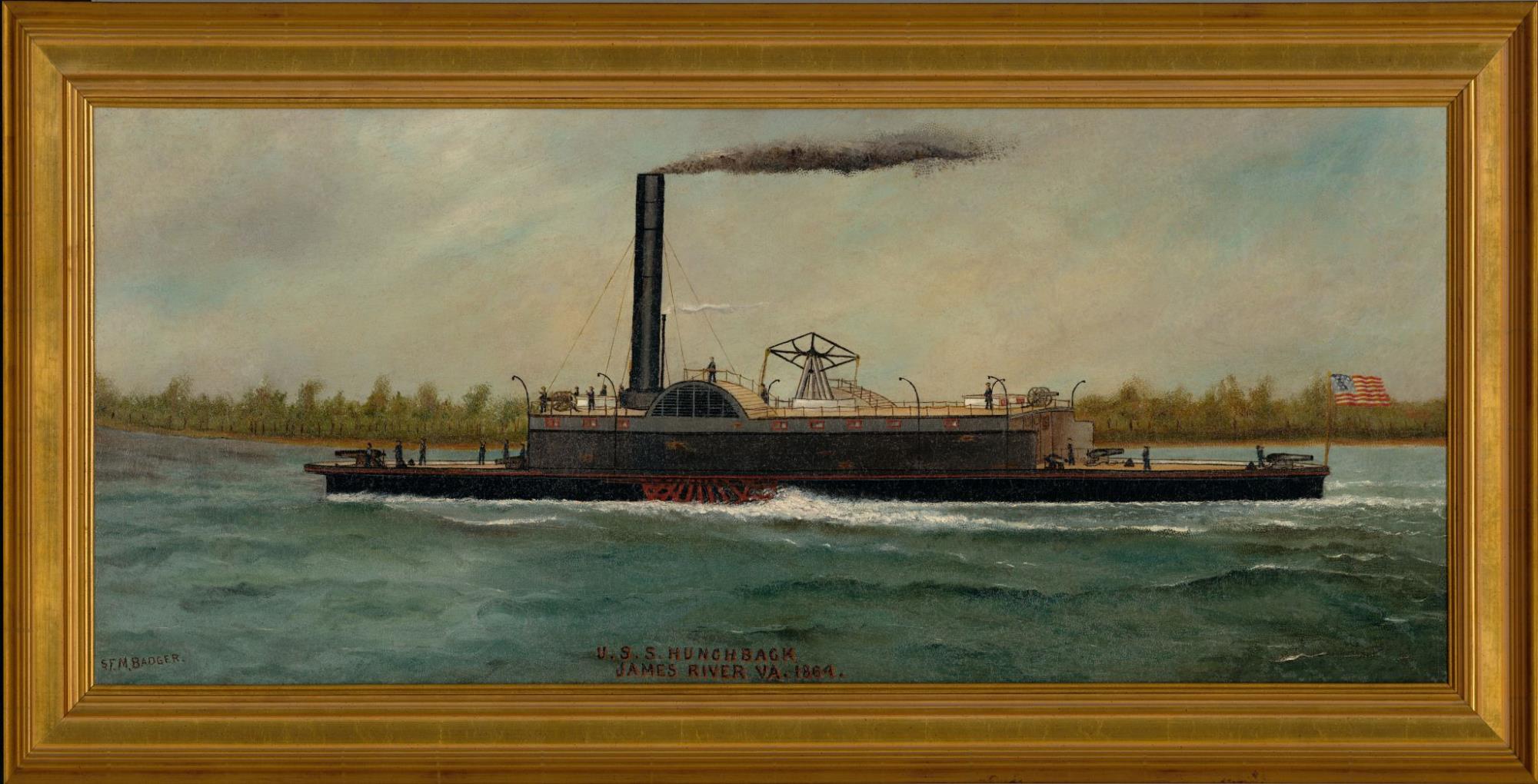 | View | ||
| 3 | 0000.1290.3293.00 | photographic prints | Barge C. W. Curlett at a drydock? in Baltimore | Baltimore - Western Shore - MD | Barge C. W. Curlett at a drydock? in Baltimore; she may be aground; timbers helter skelter on ground next to her; seen from port side; formerly Pamlico and Gove. R. M. McLane. | No image URL. | View | |||
| 4 | 0000.1290.3815.00 | photographic prints | Freighter docked at MacLea Lumber Co. warehouses a | Freighter docked at MacLea Lumber Co; warehouses and piles of lumber in background; no date, no place, no vessel name; "Pamlico" typed on print but no vessel by that name in LMV. "Fleck Engineering Co., 1619 Fleet St. Baltimore 31, MD." stamped on back. | No image URL. | View | ||||
| 5 | 0000.1290.3891.00 | photographic prints | Carved wooden frame with eagle and stars | Carved wooden frame with eagle and stars "Eagle and stars carved by Burgess and mounted on mirror from the former Coast Guard cutter Pamlico.". A Coast Guard cutter named Pamlico served from1900 to 1920, based in New Bern, NC, but impossible to tell if this is the one with the frame. | No image URL. | View |
Created 2026 by Don Barker, CBMM volunteer, for the Chesapeake Shipbuilding Project. shipbuilding@sailingworkboats.es